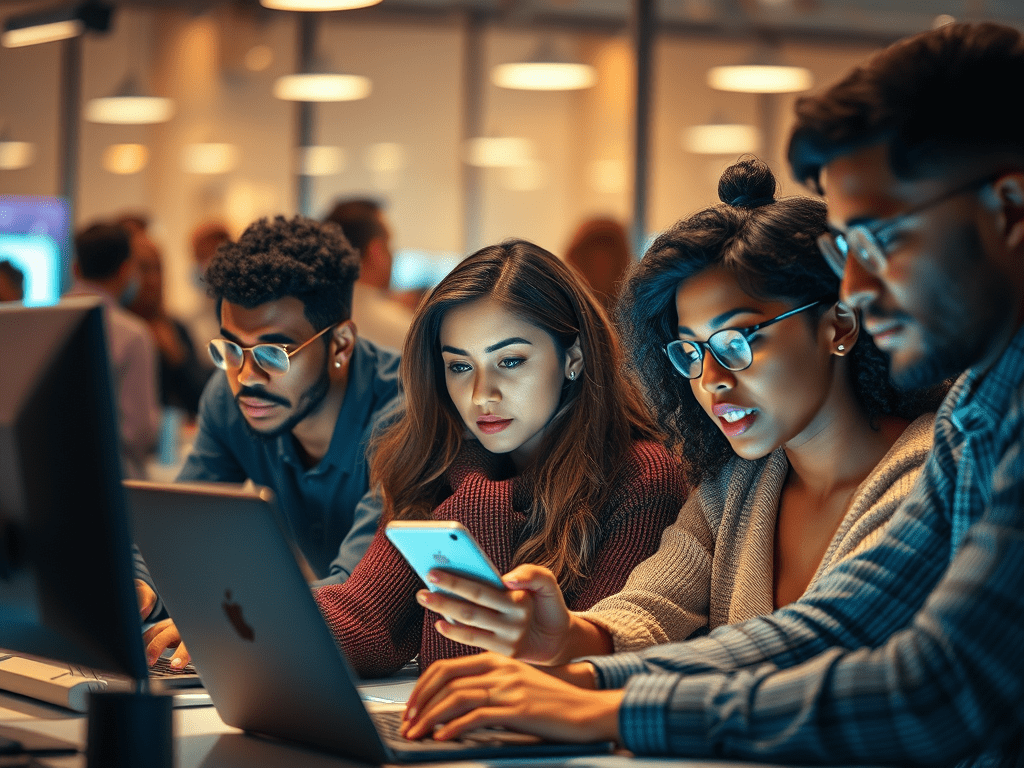
The Emergence of a Digital Society
“She can’t even spell,” I overheard my older sister’s comment about someone. Instantly, I thought to myself how outdated my sister’s comment was. Due to spell-check, a person who was once skilled at spelling has lost that ability. That is not the only issue. Personally, I have had words changed. These changes altered the context of my response. This happened easily because I hadn’t read carefully before pressing the send button. An action that can happen to anyone.
Everything that humans create has both advantages and disadvantages.
The creation of computers and their software elevates our intellect. One can choose not to incorporate them into their lives or embrace them. This choice leads to becoming wiser in thought and a better contributor to society. It has caused a retrospective look at how the introduction of computers has transformed society.
People gained the ability to communicate more quickly. They can store photos and data electronically. Yet, this progress also introduced new risks. Pictures and files, intended to support creativity and environmental sustainability, became tools for misuse—identity theft and corporate data breaches became all too common.
Some people have lost not only the ability to spell correctly and even carry on a conversation, but also their lives to cyberbullying. Questions arose about the adequacy of laws to protect individuals from these new forms of harm.
Having a computer allows us to be more engaged, as it both teaches and entertains us. Nonetheless, social media networks rely on an attention-oriented business model. This often cheapens, coarsens, and corrodes human connection on the internet. Computer and phones have become an integral part of our world, to the extent that we no longer need to leave our homes. Friends and family members have become distant in our lives, as most of our time is spent online.
Culture, Ethics, and the Law
Society’s relentless drive to be first pushes it to pursue profit. This behavior encourages the celebration of shortcuts. Sometimes, this happens at the expense of ethics. Hackers are stealing company information at a high cost to retrieve. Gaining access to individuals’ computers and disrupting their lives. Sending out email viruses that corrupt computers. These are not issues caused solely by computers, but by human behavior. Addressing the problem requires more than technical solutions; implementing stronger laws is also necessary.
With artificial intelligence now integrated deeply into daily life, there is a need to revisit and revise legal frameworks, drawing from real experiences to ensure justice for victims of digital abuse.
A recent headline brought back memories of a problematic site. This issue led me to remove my account. The title of the person’s book was the same as mine. I realized I should have investigated further after looking at this article, but I neglected to do so.
The Washington Post published an article by Will Oremus. It reported on the unauthorized use of millions of books by AI technologies. This issue is sparking lawsuits and legislative hearings.
Authors like David Baldacci testified about witnessing his son’s use of ChatGPT. His son used it to craft a plot in the style of a David Baldacci novel. In his own words, this is what he told U.S. senators at a hearing on July 19, 2025, regarding artificial intelligence and copyright. “Within five seconds, the chatbox spat out a pastiche of characters, settings, and plot twists that were uncannily familiar.”
Is AI now being used to inject criminal activity into people’s lives? It rapidly generates imitations of others’ literary styles. This underscores urgent calls for changes to copyright rules.
The Impact of Injustice
Life is meant to be enjoyed by everyone. However, many struggle against injustices. These are perpetrated by those already in positions of comfort and wealth. A lack of appreciation for fairness and justice exposes the allegiances of those who resist change.
Corruption and conflict persist because some individuals within influential institutions permit wrongdoing, allowing it to remain hidden and unaddressed. This perpetuates a culture of imitation—”Monkey see, monkey do”—where poor conduct spreads.
The Roots of Conflict
I have found that with most new products introduced into society, laws to protect the public are often considered last. They are only prioritized until a disastrous event occurs. The economy needs more jobs that cater to cybersecurity-related issues. Without such openings, the country will continue to experience more corruption that will not be easily fixed. At the heart of disputes—whether between individuals or nations—lies a failure of communication. Victims of digital abuse must speak up to help others. This will alert lawmakers to what is really happening. They can then implement laws that protect victims.
Not having devices protected with proper security software will give hackers easier access to your data. Get protection.
Put a sticker with your location on your phone. Make sure you have a hard copy of your phone’s information and passwords. I recently lost my phone, and felt as though a part of me was missing. Although my address was on it, the dishonest person has not mailed it. They have also not returned it to the lost and found department at the location.
If you’re single and living alone, consider getting some security for your apartment or home. Those who have entered my unit illegally victimize me. I fight daily to keep my sanity from deliberate actions that test my mental state.
The Erosion of Sanctuary

Homes, once sanctuaries of peace, have become battlegrounds for those whose privacy and digital lives have been violated. The fight extends to resisting psychological harm and spiritual warfare, as victims strive to preserve their well-being and sanity. The realization that material wealth carries no value beyond death remains elusive for many.
The True Power of Goodness
Power is meaningless without a sense of spirit and purpose. By choosing to do good, individuals can offer hope to those who are struggling, finding meaning in each new day. We are humans, far more intelligent than animals, and even they protect their pack. As a society, we need to look out for one another. This creates a better environment where we can all strive. It allows us to enjoy life.
Lately, with the development of new and improved software, I ask: Do we really need it? Or do we need to become better equipped at using what is already available? I’d like to hear your thoughts. Leave your comment below.
I wish you a pleasant day. Thanks for reading.
 Better The End
I think with every technological advancement we are evolving out our being part of human being into something that can be outsourced to AI and machine learning…
Who are you...if you dont have to remember, learn or know anything because its all available at your fingertips?
Am not yet sure whether the result is a good thing or bad thing or something thats inevitable so we simply evovle or perish…
~B
LikeLiked by 1 person
Beaton, as with all things, time will tell.
LikeLike